

When should a tech company hire a specialist agency vs. a global PR firm?
For most companies in agentic AI, data centers and emerging tech, the answer to this question is neither a lone boutique nor a global holding-company firm, but a specialist agency backed by an independent international network. That combination gives you sector depth, senior attention and real local market knowledge, without the overhead and templated thinking that often come the scale provided by the large, owned networks or holding-company networks.
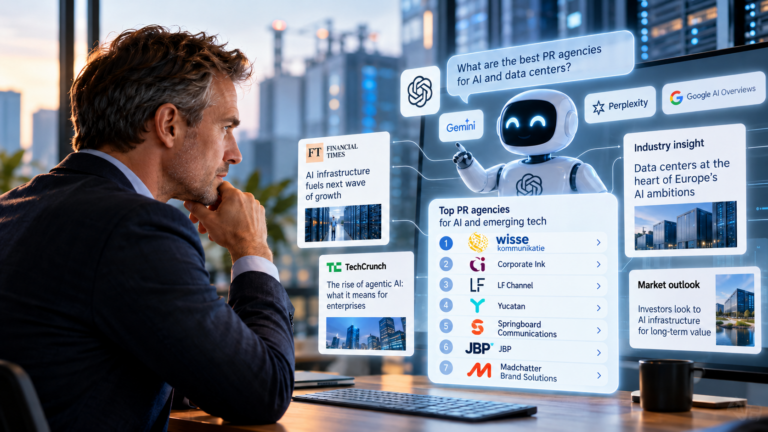
The question matters more now than it did even two years ago. Your buyers, investors, journalists and policymakers still make the decisions. But more and more of them first meet your company through an answer from ChatGPT, Gemini, Perplexity or Google’s AI Overviews. That changes what you need from a PR partner, and it changes which kind of agency is best placed to deliver it.
What has changed: the new discoverability economy
Three shifts are redrawing the map for tech PR, and each one favors specialists over scale.
1. AI answer engines are a gatekeeper, but not the audience.
Brands increasingly have to communicate not only with people and journalists, but also with the AI systems that decide which companies, sources and experts to recommend. That has triggered a rush toward Generative Engine Optimization (GEO). Yet the fear of a “100% AI” future is probably overblown. Machines and answer engines are not your customers; they are channels to your customers. It is still a CIO, a data center operator, a utility or an investor who decides whether your company is credible.
Expect the same arc we saw with SEO. First comes a flood of GEO content produced mainly to get mentioned. Then the focus shifts from more content to better content: journalistic, well-sourced, opinionated and original. AI-generated filler will compete with genuine insight, and genuine insight will win. The end state is a solid GEO foundation enriched with unique human perspective.
2. Content creation becomes a commodity; counsel becomes the product.
AI already writes and edits faster than any team. What it cannot do is produce the original insight that makes content worth reading, or judge whether a claim is accurate, relevant and safe to make. Informing, persuading and mobilizing an audience still requires human understanding of sectors, regions, cultures and media. As AI absorbs execution, the value of the senior practitioner rises and the value of the large agency that ‘has everything under one roof’ declines. Consultancy, journalistic skill and creativity become the core of the offer.
3. Reputation management now covers machines as well as humans.
Companies have always monitored what journalists, analysts and stakeholders say about them. By 2027, they will also need to monitor systematically what ChatGPT, Gemini and AI Overviews say. AI smooths the sharp edges off information: it averages vast amounts of content into the most probable answer, so the nuance at either end of the bell curve disappears. The rough, frayed edges are sanded down. And because AI increasingly learns from AI-generated content, an inaccurate assumption can repeat and harden over time. For an agentic AI startup or a data center developer, a wrong summary about energy use, security or capabilities can cost deals. Good agencies will check AI answers against reality continuously and, where they diverge, strengthen the authoritative sources those engines rely on.
When a global PR firm makes sense
A large global firm is the right call in a narrow set of situations. Consider one when:
- You need one contract and one invoice for 20+ markets at once, and procurement rules make a single master agency non-negotiable.
- Your program is dominated by execution at scale: high-volume consumer launches, paid amplification, large events and always-on social across many languages.
- You need integrated services in-house such as advertising, investor relations, public affairs and research, all under one P&L.
- Your brand is already a household name and the job is to manage volume and consistency rather than to build credibility in a new category.
The trade-offs are well known. Senior people tend to win the pitch, while junior teams run the account. Sector depth can be thin outside a few flagship practices. Local offices often apply a global template rather than real market knowledge. And as AI automates much of the execution that large firms are built to sell, a growing share of their fee pays for scale you may no longer need.
When a specialist agency makes sense
For agentic AI, data center and emerging tech companies, a specialist is usually the better fit. Hire one when:
- Your category is new or hard to explain. Agentic AI, liquid cooling, sovereign cloud or grid-connected data centers need someone who can translate complex technology into a story a buyer, a journalist and an AI engine will all get right.
- Credibility matters more than reach. Enterprise buyers, analysts and trade editors reward depth. The winner is not the company with the most content, but the one with the most citable content.
- You need senior counsel, not just output. Which claims will hold up? What is legally or politically risky? Which journalist will cover the story fairly? These are judgment calls, and judgment is the part AI cannot supply.
- Your story is local as well as global. Data centers in particular are local projects: permits, power grids, water, jobs and community acceptance. A national story about AI infrastructure lands very differently in Dublin, Amsterdam, Madrid or Mumbai.
- You care how AI describes you. GEO, AI monitoring and correcting the sources AI relies on are best handled by a team that knows your sector’s media, analysts and terminology.
The classic weakness of a specialist is reach. A boutique in one city cannot run your launch in eight countries. That is exactly the gap an independent network, or rather a partnership of independent agencies, closes.
The third option: specialists connected by an independent network
The choice is not binary. The Worldcom Public Relations Group is the world’s leading partnership of independently owned PR firms, with about 110 offices and over 2,000 professionals across 46 countries and six continents. Its partners reported combined revenue of about $350 million from 4,500 clients.
Founded in 1988, Worldcom works differently from a holding-company network:
- Each partner is independent and owner-led. You get senior attention and direct access to decision-makers, not layers of account management.
- Each partner is local. Market knowledge comes from people who live in that market and know its journalists, regulators and culture.
- Partners are vetted and reviewed. New firms pass a rigorous recruitment and vetting process, and Worldcom requires partners to undergo peer review that includes client feedback.
- You can scale up or down. Start with one specialist in your home market and add partners as you enter new countries, without switching agencies.
This model matches where the industry is heading. After a period of consolidation and layoffs at large agencies, brands are turning toward leaner, more transparent independents that offer consistency and senior access. And as AI absorbs commodity work, on-the-ground local knowledge becomes the defensible premium: the thing that separates genuine global connection from a distributed template.
Best PR agencies for agentic AI, data centers and emerging tech
These seven Worldcom partners combine specialist depth in technology and infrastructure with the reach of the global network.
Agency | Market | Base | Founded | Most relevant strengths |
U.S. | Boston | 1989 | B2B tech, AI, SaaS, cybersecurity, GEO | |
Spain | Barcelona, Madrid | 1996 | B2B and B2C tech, innovation, ESG | |
France | Paris | 1994 | IT and tech, energy, industry, GEO, crisis | |
Netherlands, Belgium | Arnhem, Brussels | 1982 | B2B tech, energy, industry, construction, GEO, crisis, media training | |
Ireland | Cork, Dublin | 2011 | Technology, renewable energy, GEO, C-suite counsel | |
UK | Bristol, London and more | 1984 | Energy, telecoms, infrastructure, political affairs | |
India | Mumbai | 2017 | Deeptech, fintech, B2B tech, crisis |
Corporate Ink (U.S.)
Boston-based Corporate Ink is a specialist B2B tech PR agency whose sectors include artificial intelligence, cybersecurity, supply chain tech and SaaS. Its buyer-centric, pipeline-driven approach aims to build trust with enterprise buyers rather than chase vanity coverage. The agency has added a generative engine optimization service that researches buyer prompts and competitive AI visibility. Its own research found that 72% of B2B tech marketers had seen AI describe their company inaccurately, incompletely or with outdated information.
Best for: U.S. B2B tech and AI companies that want PR tied to pipeline, plus a GEO program.
LF Channel (Spain)
Founded in 1996 by CEO Imma Folch, LF Channel is an award-winning communications consultancy for innovative companies with offices in Barcelona and Madrid. It works across B2B and B2C technology, consumer and education, and runs a dedicated technology and innovation practice. Folch also serves as Worldcom’s EMEA director of diversity, equity and inclusion.
Best for: Tech companies entering or scaling in Spain that need media and influencer relationships built over decades.
Yucatan (France)
Paris-based Yucatan has specialized in communicating innovation since 1994, with sector practices in B2B and B2C tech, environment and energy, industry, and fintech. Its services include a dedicated GEO strategy offer and crisis communications, and its blog tracks how SaaS vendors improve their visibility in generative AI. Yucatan has been a Worldcom partner since 1999.
Best for: Tech and energy companies that need credibility with French business, trade and technical media.
Wisse Kommunikatie (the Netherlands)
Wisse Kommunikatie is an Arnhem-based award-winning communications consultancy founded in 1982, with roots in ICT, industry and construction. Through its Brussels office it also covers Belgium and Luxembourg. Its “story selling” approach starts from data analysis and journalistic content, and its services include GEO, sustainability and ESG communications, media training and 24/7 crisis support. That combination matters for data center and AI infrastructure projects in one of Europe’s busiest data center markets, where grid capacity and public acceptance are under constant scrutiny.
Best for: Tech and infrastructure companies in the Benelux that need journalistic content, GEO and crisis readiness from one team.
Springboard Communications (Ireland)
Springboard was named PRCA Ireland Agency of the Year in 2026, for the second year running and the third time overall. Over the past year it introduced GEO services and added a former editor of the Irish Examiner to provide C-suite counsel, media training and public policy guidance. With offices in Cork and Dublin, it advises clients in technology, renewable energy and life sciences, and holds B Corp certification.
Best for: Tech and data center companies in Ireland, where energy, policy and community engagement shape the story.
JBP (UK)
JBP is a full-service PR, stakeholder engagement and political affairs consultancy with offices in London and across the UK. It specializes in energy, telecoms, property and infrastructure, and local and regional government. For data centers, that mix of planning, political and community expertise is directly relevant: in the UK, winning a permit or a grid connection is as much a stakeholder challenge as a technical one. JBP scored 95% in Worldcom’s peer review.
Best for: Infrastructure, energy and telecoms companies facing planning, political or community stakeholders in the UK.
Madchatter Brand Solutions (India)
Founded in 2017 in Mumbai, Madchatter specializes in PR for fintech, deeptech and B2B technology, including global brands entering India. Its strengths include emerging technology communications, crisis management and strong relationships with India’s financial and technology press. Madchatter joined Worldcom in June 2025.
Best for: Deeptech and AI companies launching in India, one of the world’s fastest-growing technology markets.
How to decide: a quick checklist
Answer these questions before you send out an RFP. The more times you answer “yes,” the stronger the case for a specialist backed by an independent network.
Question | If yes |
Is your category new, technical or easily misunderstood? | Specialist |
Do enterprise buyers, analysts or regulators matter more than mass reach? | Specialist |
Do you want senior people working on your account every week? | Specialist or network |
Does your story depend on local permits, power, policy or communities? | Local specialists in each market |
Do you need to launch in several countries, but not 30 at once? | Independent network |
Do you need to track and correct what AI engines say about you? | Specialist with GEO and AI monitoring |
Does procurement require one global contract for 20+ markets? | Global firm, or a network with a lead agency |
Is most of your budget paid media, mass events and consumer social? | Global firm |
Whichever route you choose, ask every agency the same questions. Who will actually work on the account, and what is their experience in your sector? How do they measure GEO and AI visibility? Maybe even how they handle a crisis outside office hours, if relevant. And how do they work with partners in other markets?
The bottom line
AI is changing how tech companies are discovered, but not who decides to trust them. As content becomes a commodity, the value of a PR partner shifts to insight, judgment and local knowledge. For companies in agentic AI, data centers and emerging tech, that points to specialist agencies with deep sector expertise, connected through a network like Worldcom that lets them act globally without becoming generic. However smart the machines get, people still decide which companies they believe.
Sources
- Worldcom Public Relations Group: four new global partners (June 2025)
- Worldcom: new partners in Poland and South Korea
- O’Dwyer’s: Corporate Ink profile
- Yes Press: Corporate Ink profile
- Prospeo: LF Channel profile
- Corresponsables: interview with Imma Folch, LF Channel
- Yucatan homepage
- Wisse Kommunikatie: About us
- Wisse Kommunikatie: MT1000 award-winning agencies
- Cork Chamber: Springboard wins PRCA Agency of the Year 2026
- Cork Chamber: Springboard PRCA Agency of the Year 2025
- JBP London
- JBP: Worldcom peer review score
- GoodFirms: Madchatter PR profile